

The Canadian news industry spent the better part of two decades declining steadily, then accelerated. In 2024, Statistics Canada recorded total operating revenue for newspaper publishers at $1.6 billion – a 17.9 percent fall from 2022 alone. Salary spending fell 17.6 percent over the same two years. Operating profit margin: 3.2 percent. In 2006, that margin was 13.2 percent on $5.34 billion in total revenue. The structure of the business has not recovered. It has contracted.
Seven areas, all documented: newspaper circulation numbers, Atlantic media ownership concentration, newsroom restructuring, journalism graduate programs in Canada, the internship path, election coverage research, and what journalism awards reveal about an industry under pressure.
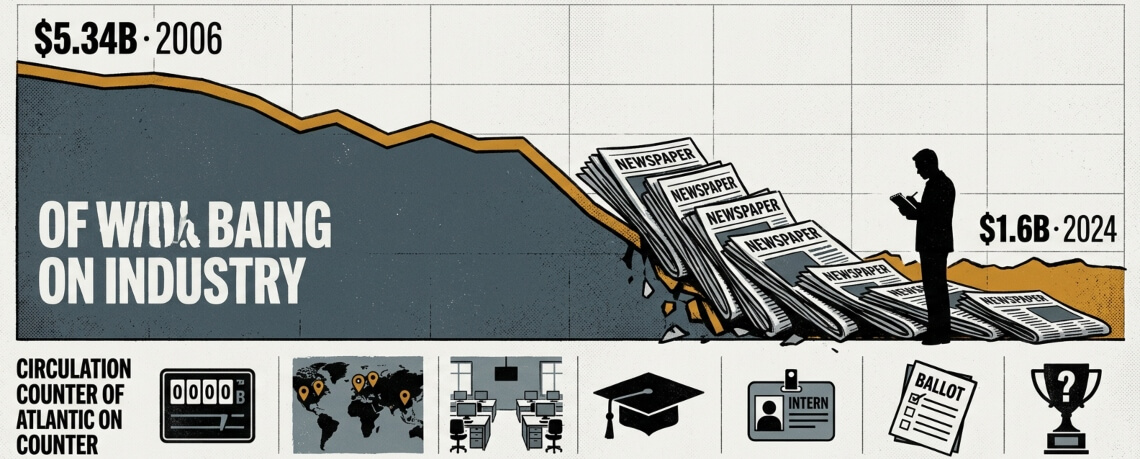
$1.6B
newspaper publisher revenue 2024
Statistics Canada, Nov 2025 – down from $5.34B in 2006
-34.3%
print advertising decline, 2022 to 2024
Statistics Canada – digital ad revenue also fell 11.9%
$1M
Postmedia paid for SaltWire Network, August 2024
Halifax Chronicle Herald + 25+ Atlantic papers
1938
when Section 329 Canada Elections Act was first enacted
Repealed June 19, 2014 as part of Fair Elections Act
Newspaper Circulation Canada: What the Numbers Show
In 2016, Canada had 98 daily newspapers with an average daily print and digital circulation of 5.2 million. By 2022, print circulation revenue had fallen 12 percent from 2020 to $459.7 million; digital grew 65.5 percent but only reached $131.1 million. The numbers don’t offset each other. By 2024, print daily newspaper circulation sales fell a further 11 percent. Total circulation revenue reached $541.1 million, down 7.6 percent from 2022.
Community papers tell a different story. As of June 2023, total newspaper circulation across Canada, daily and community combined, was over 28.19 million (News Media Canada). Nearly 14 million are community papers, most free to readers. Circulation increased in eight of thirteen provinces and territories between 2021 and 2022. For most Canadians outside major centres, the community paper is the only local news that exists.
The structural problem is advertising. From 2022 to 2024, print advertising fell 34.3 percent to $407.7 million. Digital advertising fell 11.9 percent to $315.1 million. Both lines moved in the same direction. An operating margin of 3.2 percent cannot sustain the staffing that quality journalism requires.
Media Concentration in Atlantic Canada: What the Research Documents
The research on media concentration in Atlantic Canada, documented in analyses framing the situation as media by monopoly, describes a situation that came fully into being in August 2024.
Postmedia Network acquired SaltWire Network and the Halifax Herald for $1 million after SaltWire’s insolvency proceedings at the Nova Scotia Supreme Court. Postmedia had already taken Brunswick News in 2022. The result: one company, 66 percent owned by US hedge fund Chatham Asset Management, controls virtually every English-language daily in four provinces.
Media ownership concentration at this scale is not an abstraction. When one ownership group controls most of a region’s news coverage, corporate decisions, which beats to staff, how many reporters, whether to publish, directly affect what four provinces’ residents can learn about their own governments. The Telegram in St. John’s, a 145-year-old daily, printed its last daily edition on August 24, 2024. Four of 13 newsroom positions were eliminated. It became a weekly printed outside the province.
Newsroom Layoffs Journalism: Patterns in the 2023 to 2025 Wave
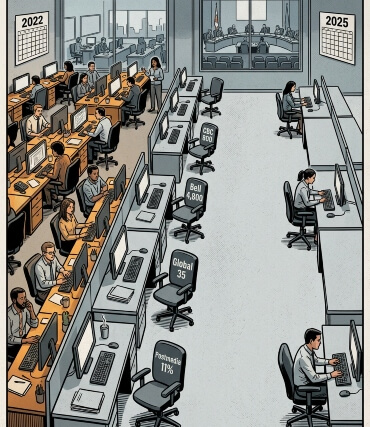
The wave of newsroom layoffs in journalism between 2023 and 2025 went beyond annual budget adjustments. CBC/Radio-Canada announced roughly 800 position cuts in 2023-2024. Bell Media laid off 4,800 employees and sold 45 radio stations in February 2024 – a document distributed to employees described the changes as necessary to address structural revenue decline. Global News cut 35 jobs in June 2024 and 45 more in September 2025. Postmedia cut 11 percent of editorial staff in January 2023.
A strategic review of news operations preceded each major announcement. The CAJ called the pattern plainly: layoffs may serve as a short-term stopgap to beleaguered balance sheets, but they further destabilize and shortchange democracy. Newsrooms that survive these rounds are not the same organizations that went into them. A newsroom that loses 30 percent of its reporters covers fewer stories, attends fewer council meetings, and produces less original accountability journalism.
Journalism Graduate Programs Canada
Canada has approximately a dozen university journalism programs and a larger number of college diploma programs. The range matters: not everyone studying journalism heads toward a graduate program, and not every newsroom hires from them.
Carleton’s School of Journalism and Communication, established in 1945, enrolls roughly 1,900 students. It runs a paid CBC North internship exclusive to Carleton, a Global Journalism International Internship program since 2006, and a Globe and Mail mentorship program for Indigenous and racialized students renewed in 2025. TMU’s School of Journalism includes an optional internship placement in the final year and a mandatory newsroom internship in the graduate program; it is also home to the Local News Research Project, the most comprehensive source of data on newsroom openings and closings in Canada.
Western University’s MMJC began as a proposal for a new specialized master’s program in journalism and communications. It is now a reality: Canada’s only professional master’s degree combining both disciplines, with applications for September 2026 open as of October 2025. UBC added a new AI and journalism course for 2025-2026. Carleton introduced an Indigenous journalism certificate with an in-person intensive in early 2026.
How to Choose the Right Program
What to evaluate when choosing a program: faculty with current industry experience; demonstrated newsroom internship placement rates, whether the curriculum covers data journalism, AI ethics, and investigative methods. The field moves faster than academic approval cycles.
Newsroom Internships: How Entry Has Changed
In 2006, Carleton launched its Global Journalism Internship program with Farm Radio International. That program still runs. What has changed is what graduates are entering. The combination of layoffs, consolidation, and revenue decline means fewer permanent positions exist.
The Dallas Morning News internship was well regarded in North American journalism education for years as a model of structured entry-level training: rigorous application criteria, supervised reporting, clear evaluation. The 2026 equivalent at Canadian outlets is less standardized. Some programs have formal criteria, many operate informally, and the path from internship to staff position is less predictable than a decade ago. The Federal Job Bank’s 2023-2025 employment outlook for journalists was ‘moderate’ – demand continued, but longevity was uncertain.
Election Coverage Research Canada: What the Studies Show
In 2008, Canadian news sites faced a concrete legal problem on election night: Western results couldn’t be published until polls closed in B.C., a rule written before the internet existed. Section 329 of the Canada Elections Act, enacted in 1938, banned the transmission of results between ridings with open and closed polls. A poll done by Ipsos Reid in 2008 on debate coverage found that audiences were already consuming election information across channels in ways the law hadn’t anticipated.
The AEJMC-Carleton election study examined newspaper website coverage constraints that same year. The etude that emerged from that research documented how the legal restriction created editorial paralysis in online newsrooms. Election night coverage in Canada was subject to this ban until it was formally repealed June 19, 2014, as part of the Fair Elections Act.
The episode illustrated a durable pattern: media law catches up to technology slowly. Research on how journalists actually cover elections consistently finds a gap – not legal now, but resource-based. Fewer reporters, more ridings, less time for the verification that distinguishes journalism from information circulation.
What Excellence in Journalism Gets Rewarded
Read all about the criteria for what they say makes excellent journalism, in the Canadian Journalism Foundation’s award guidelines, the Michener Awards’ adjudication standards, and the RTDNA’s evaluation criteria, and a consistent picture emerges: original investigation, documented sources, breadth, clarity, and public impact.
The CJF runs the Jackman Award for Excellence in Journalism, the Climate Solutions Reporting award, and the Burtynsky Climate Photojournalism award. It also operates the Black Journalism Fellowships, the Indigenous Health Journalism Fellowship, and the CJF-CBC Indigenous Journalism Fellowship. The Michener Awards recognize public-service journalism that produced a documented response or change. RTDNA Canada covers broadcast. The National Newspaper Awards cover print and digital.
Excellence in journalism awards consistently reward work that required time, staffing, and editorial support. Those three inputs are in shorter supply in 2026 than they were a decade ago.
FAQ
Total circulation revenue fell to $541.1 million in 2024, down 7.6% from 2022. Print daily newspaper circulation fell 11% from 2022 to 2024. Community paper circulation was more stable, with increases in 8 of 13 provinces and territories between 2021 and 2022 (News Media Canada).
As of August 2024, Postmedia Network controls virtually every English-language daily in Atlantic Canada following its $1-million acquisition of SaltWire Network and the Halifax Herald. Postmedia is 66% owned by US hedge fund Chatham Asset Management.
Major programs include Carleton University (est. 1945), Toronto Metropolitan University, Western University’s MMJC, UBC, Concordia, King’s College, University of Regina, and Ryerson. College diploma programs at Humber, Sheridan, NAIT, BCIT, and others provide faster entry paths to newsrooms.
Carleton’s Global Journalism Internship program (since 2006), TMU’s mandatory graduate placement, and CBC North internships are among the most structured. Availability varies significantly by outlet and market.
The Michener Award for public-service journalism is widely regarded as the most significant recognition for accountability reporting. The Canadian Journalism Foundation’s Jackman Award covers broader excellence. RTDNA Canada covers broadcast journalism. The National Newspaper Awards cover print and digital.
Note: Statistics Canada publishes newspaper publisher data every two years. The figures cited here are from the November 2025 releasecovering 2024. Figures for 2026 are planned for release in 2027.