

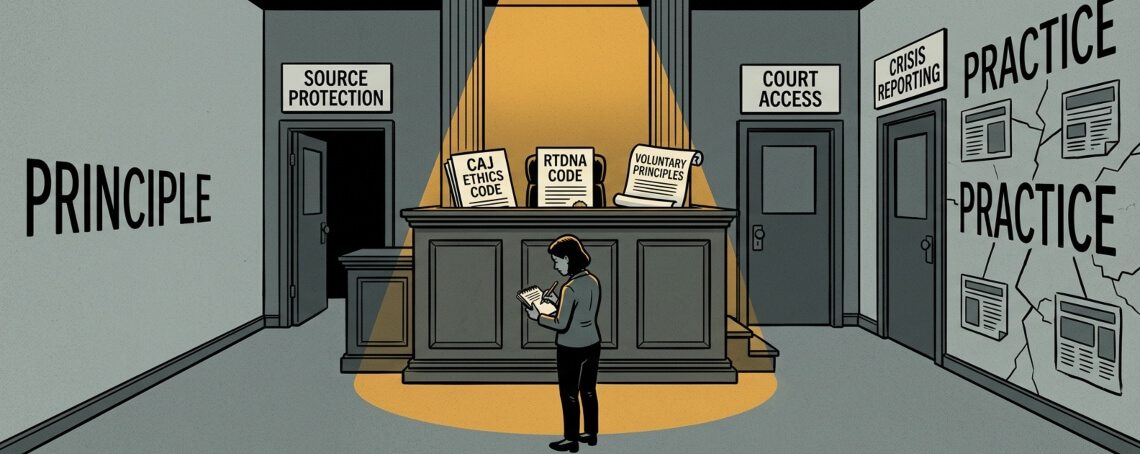
There is no journalism regulator in Canada. No licensing body. No professional organization with the power to sanction a working reporter. What exists instead are voluntary codes, the CAJ’s Principles for Ethical Journalism and Ethics Guidelines, the RTDNA Canada Code for broadcasters, and a broad consensus that meeting them is left to individual newsrooms and individual editors.
The CAJ’s 2023 revision states it plainly: accuracy is the imperative of journalists and news organizations. Source protection, conflict of interest, harm reduction, and court access all follow from that premise. But a premise is not a mechanism. Canadian newsrooms differ significantly in how they apply these principles, and many have no written policy beyond the CAJ guidelines themselves.
Here we cover three areas where the gap between principle and practice is most visible: what the ethics codes actually require; how source protection for journalists and court access work under Canadian law; and what crisis journalism – kidnapping coverage, hostage situations, trauma reporting – demands that most codes don’t address.
2023
CAJ Ethics Guidelines most recent revisio
Adds explicit guidance on AI and misinformation
20th
Canada’s press freedom rank, RSF 2025
Down from 14th – economic fragility and concentration cited
40+
documented kidnapping cases reviewed by CAJ researchers
No consistent pattern found across outcomes
2026
Bracken v. RCMP trial, BC Supreme Court
Landmark Charter rights case, resumes April 2026
What Ethics Codes Actually Require
The CAJ Ethics Guidelines and the RTDNA Canada Code of Journalistic Ethics cover the same core territory: accuracy, fairness, independence, conflict of interest, source protection, and harm reduction. Both are voluntary. Both apply to different segments of the industry – print and digital for the CAJ, broadcasters for RTDNA.
CBC has its own guidelines – the Journalistic Standards and Practices document, published publicly and updated regularly. It goes further than the CAJ on some specifics, particularly around AI disclosure and unnamed sources. The difference matters: CBC is a public broadcaster with a formal accountability structure. Most Canadian newsrooms are not.
The Canadian Newspaper Association, now operating as News Media Canada, has historically represented publishers rather than journalists. Ethics enforcement has remained largely internal to individual newsrooms, which is why standards vary so significantly between a national daily and a community paper with three reporters.
The CAJ’s ethics advisory committee issues policy papers on emerging issues: paying for information, sponsored content, social media conduct, and online comment moderation. These papers are not binding but represent the closest thing Canadian journalism has to a living professional standard. The 2023 revision added explicit guidance on AI and misinformation, the first substantive update to address generative tools directly.
How Press Complaints Work in Canada
Canada has no national press council. Filing a press council complaint in Canada means navigating a patchwork of bodies with inconsistent jurisdiction and no unified standard.
The National NewsMedia Council covers most English-language print and digital outlets outside Quebec. The Conseil de presse du Quebec handles francophone media. CBC has its internal ombudsman process. RTDNA Canada handles broadcaster complaints. None of these bodies can impose fines or compel corrections.
A reader who believes a story about them violated journalism ethics in Canada has options, but no guaranteed outcome. The process for submitting a complaint to a press council is public and free. The result, even if upheld, cannot be enforced.
The legal side is different. And often messier.
Court Access, Fair Comment, and What Journalists Need to Know
Section 2(b) of the Charter protects freedom of expression and, by interpretation, freedom of the press. That protection coexists with an extensive system of publication bans that restrict what journalists can report.
Bail hearing details, sexual assault complainant identities, and the names of young offenders are protected by automatic bans under the Criminal Code. Discretionary bans can be issued by judges on application. Journalists covering courts need to check for bans at the start of every proceeding.
Fair comment law in Canada provides a defense in defamation cases for opinion and commentary, but the defense requires that the comment be based on fact, relate to a matter of public interest, and represent an honest opinion. Understanding fair comment as a legal concept matters for any journalist writing analysis or criticism. The Justice Reporter, a resource developed specifically for journalists covering courts and the legal system, covers these distinctions alongside publication ban law and courtroom access rules.
The current test case for physical press access is Bracken v. RCMP, which began trial at BC Supreme Court on January 12, 2026, ran five weeks, and is expected to resume in April. Photojournalist Amber Bracken was arrested in November 2021 covering Coastal GasLink pipeline enforcement on Wet’suwet’en territory. The case could produce the clearest judicial statement on what press freedom in Canada means at an active enforcement scene.
Source Protection for Journalists: The Legal Gap
Canada has no federal shield law. Source protection for journalists exists not as a statutory right but as a discretionary outcome of a judicial balancing test established in R. v. National Post (2010). Courts weigh four factors: whether the relationship was confidential, whether confidentiality was essential to it, whether the public benefits from encouraging such relationships, and whether disclosure harms outweigh the benefit of the evidence. The test is applied inconsistently.
The CAJ launched Lawyers for Reporters in December 2025, a program providing journalists with legal counsel when source protection disputes arise. Academic theses and research papers have documented the chilling effect: in smaller markets, the absence of legal protection means reporters self-censor before the question of disclosure even reaches a courtroom.
Crisis coverage adds a layer that most ethics codes don’t address.
Kidnapping Reporting Guidelines: The Decision No Code Fully Resolves
Researchers who analyzed documented kidnapping cases compiled a chart summarizing the news media’s response across more than forty incidents: roughly half resulted in a blackout agreement, half did not. The outcomes don’t support a clear conclusion about which approach produces better results for hostages.
The CAJ reviewed this record and found no consistent pattern. The factors – location, captor identity, whether the victim is a journalist or civilian, whether government officials have requested silence – interact differently in every case. Kidnapping reporting guidelines exist at individual organizations, but no industry-wide standard does.
CBC’s guidelines on covering kidnapping address the basic principle: minimize information that could endanger a hostage. In 2008, most major Canadian outlets honored a blackout for 28 days after CBC journalist Mellissa Fung was kidnapped in Afghanistan. When diplomat Robert Fowler was taken the same year, the situation was more complicated – different captors, different media dynamics, no unified response.
Crisis journalism of this kind falls outside what ethics codes can fully specify. The decision is made under time pressure, with incomplete information, by editors who may never have faced it before.
Trauma-Informed Reporting: What the Research Shows
The Dart Center for Journalism and Trauma built the most comprehensive body of practice on trauma-aware reporting over 25 years. Columbia University ended its hosting arrangement in 2025. The work continues through the Global Center for Journalism and Trauma, an independent nonprofit that reports a dramatic increase in requests for newsroom training – from local reporters facing harassment at city council meetings, not only war correspondents.
In Canada, TraumaAwareJournalism.org was developed jointly by Dart, CBC/Radio-Canada, and the Canadian Journalism Forum on Violence and Trauma. A 2022 national study documented patterns of traumatic stress among Canadian media workers. Academic theses examining newsroom practices across Canadian outlets consistently find that reporters who understand trauma psychology conduct better interviews, recognize distress in sources earlier, and cause less secondary harm.
Trauma-informed reporting is not a protective measure for journalists at the expense of the story. The research makes the case for better journalism, not easier journalism. The Rory Peck Trust and CPJ publish safety guides for freelancers working in high-risk environments.
If we want to maintain that there is this entity that we call journalism as a profession, then we do have to arrive at a basic understanding of whether altering our archives is okay or not.
— Deborah Dwyer, Reynolds Journalism Institute
FAQ
No. The CAJ, RTDNA, and provincial press councils are voluntary and carry no enforcement power. There is no licensing body for journalists in Canada.
No. PIPEDA does not require news organizations to delete published content. Removal requests are handled as editorial decisions, not legal obligations.
There is no federal shield law. Courts apply the four-part R. v. National Post balancing test. Protection is granted at judicial discretion, not guaranteed by statute.
Individual organizations, primarily CBC and major print outlets, have internal guidelines. No industry-wide Canadian standard exists as of 2026.
For English-language media outside Quebec: the National NewsMedia Council (newsmediacouncil.ca). For Quebec: the Conseil de presse du Quebec. For CBC: the CBC Ombudsman. All processes are free and open to the public.
Disclaimer: This content is educational and does not constitute legal advice. Journalists in dangerous situations should consult professional safety advisors.