

Note: French-language sections of this page use French institutional names and document titles as they appear in primary sources. All French terms are explained in context.
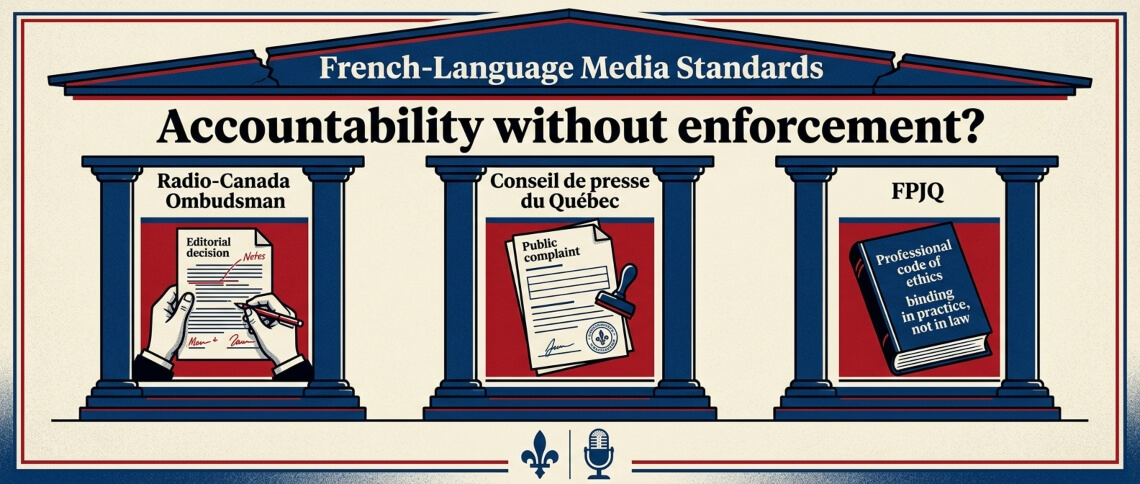
Francophone media accountability in Canada operates through three institutions that have no direct equivalent in English-language media: Radio-Canada’s ombudsman for French services, the Conseil de presse du Quebec (CPQ), and the Federation professionnelle des journalistes du Quebec (FPJQ). Each serves a distinct function. Together they cover internal editorial review, public complaint resolution, and professional ethics standards.
What does accountability look like when there’s no regulator, no licensing body, and no enforceable standard? In French-language media in Canada, it looks like this: a broadcaster’s ombudsman publishing formal revisions of editorial decisions, a press council adjudicating public complaints, and a professional federation whose code shapes practice without carrying legal force. We cover each institution in detail, along with the research on how well they work, Le Devoir’s unusual ownership structure, and primary resources for francophone media professionals.
1992
Radio-Canada ombudsman des services francais established
First annual report covers 1992-1993
147
complaints received by Conseil de presse du Quebec in 2023
CPQ Rapport d’activites 2024
$600K
Quebec government annual funding for CPQ, 2024-2026
Increased from $350K – Minister Lacombe, 2024
1910
Le Devoir founded – structurally unsellable since day one
Henri Bourassa, January 10, 1910
The Ombudsman Role at Radio-Canada
Radio-Canada’s ombudsman for French services, the ombudsman des services francais, has operated since 1992. The mandate is specific: investigate public complaints about journalistic practices, assess them against Radio-Canada’s Normes et pratiques journalistiques (NPJ), and publish findings. The ombudsman cannot impose changes on the newsroom. The role is review and recommendation, not enforcement, and the distinction matters.
The ombudsman publishes each formal finding as a revision, in French, une revision, a public document examining specific editorial decisions. These are indexed by volume and date at cbc.radio-canada.ca. Volume XVI, numero 22, dated April 23, 2008, examined Radio-Canada’s coverage of the Quebec leaders’ debate that year. For each revision, the site provides the full details: the complaint summary, the editorial response, and the finding.
What Recent Annual Reports Show
The 2023-2024 annual report documented an unusually concentrated complaint volume: 50 of the 62 complaints handled by ICI PREMIERE in that period targeted a single broadcast. The ombudsman’s revision of the file, published as “Manipuler avec soin”, found no violation of journalistic standards in the interview itself. But it a conclu that publishing an excerpt on Instagram without sufficient context breached the NPJ. Radio-Canada’s management acted on the finding and removed the post.
The 2024-2025 report addressed a different question: whether Radio-Canada’s coverage of the Trump presidency was proportionate. The ombudsman described it as a genuine editorial dilemma – how much attention a public broadcaster should give a foreign leader whose declarations have direct consequences for Canada. The report did not find a violation. It did call on management to reflect on the pattern.
The ombudsman is appointed for a five-year term, operates at arm’s length from management, and maintains a central register of all complaints and observations. Periodic thematic reviews, examining coverage of specific subjects across a span of time, are conducted when the ombudsman and management agree a systemic question needs examination.
Il ne faudrait pas que la couverture du president Trump, aussi pertinente soit-elle dans le contexte actuel, provoque la desertion d’une partie de l’auditoire. (‘Coverage of President Trump, however relevant in the current context, should not drive away part of the audience’’)
Rapport annuel de l’ombudsman des services francais, 2024-2025
How the Conseil de Presse du Quebec Handles Complaints
The Conseil de presse du Quebec is a private, not-for-profit body that has handled public complaints about journalistic ethics across Quebec media – print, broadcast, and digital – for 50 years. Unlike Radio-Canada’s internal ombudsman, the CPQ is external. Any member of the public can file a complaint against any outlet in its jurisdiction, whether or not that outlet is a member.
In 2023, the CPQ received 147 complaints. Of those, 119 files were opened for analysis; 68 were deemed admissible; the complaints committee rendered 35 decisions. The wait time for a decision has dropped to under one year – it had reached nearly two years during the 2021-2022 pandemic surge in complaints. The CPQ’s rapport d’activites 2024 notes this as a significant operational improvement.
In 2024, the Quebec government increased the CPQ’s annual operating support from $350,000 to $600,000 for the 2024-2025 and 2025-2026 fiscal years. The CPQ used this funding to create a new directeur de l’information et de la formation position, expanding its journalism ethics education work into newsrooms and journalism schools across Quebec. A revised Guide de deontologie journalistique, 2e edition, was published in 2024.
Mediation is available as an alternative to formal adjudication, free of charge to both parties. The CPQ’s guide, available in English and French at conseildepresse.qc.ca, distinguishes factual from opinion journalism, sets standards for accuracy, balance, source protection, and fairness, and applies equally to journalists and media outlets. All decisions are published.
The FPJQ: Code, Enforcement, and Structure
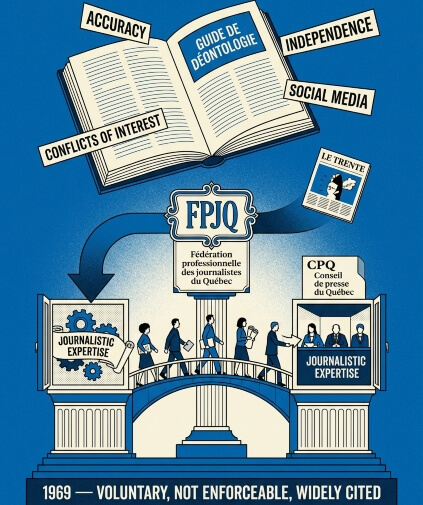
The Federation professionnelle des journalistes du Quebec has defended press freedom and the public’s right to information since 1969. Its Guide de deontologie, a voluntary professional code covering accuracy, independence, identification, conflicts of interest, and social media use, establishes the normes du journalisme quebecois that shape professional practice across the province’s newsrooms. The code is not legally enforceable, but it is widely cited in CPQ proceedings and in newsroom discussions about what constitutes acceptable practice.
The structural link between the FPJQ and the CPQ is direct: the FPJQ delegates seven of its professional members to sit on CPQ adjudication panels. These delegates participate in complaint decisions alongside representatives of media organizations and of the public. The FPJQ does not rule on complaints directly, but its members carry journalistic expertise into the CPQ’s process.
The FPJQ publishes Le Trente, a digital magazine for journalism professionals. It issues prises de position, formal positions on media policy, press freedom, and working conditions, dating through early 2026. Membership is open to working journalists and journalism students.
Academic Research on Francophone Journalism
The Centre d’etudes sur les medias at Universite Laval is Canada’s most active research centre on francophone media. It serves as the Canadian partner institution for the Reuters Institute’s Digital News Report, publishing annual analyses in both English and French. The 2025 edition found that 54 percent of Canadian respondents consider influencers a primary source of misinformation, ahead of political actors and foreign governments.
Marc-Francois Bernier, whose work appears in the original backlinks connected to this domain, published an analysis of the Radio-Canada ombudsman as an accountability model in the Canadian Journal of Communication. His introduction to that research, and a seminaire he led on Le Devoir’s editorial practices, examining how the paper’s structural independence translates into day-to-day decisions, are among the most cited primary sources on francophone journalism accountability in Canada. His study a conclu that the ombudsman’s constraint is consistent with most North American media ombudsman models, which rely on transparency and public record rather than compulsion.
Concordia University’s journalism department includes francophone media research explicitly among its areas of focus, with programs on the political economy of journalism and documentary filmmaking that engage directly with Quebec’s media landscape. The seminaire tradition in francophone journalism education, intensive peer critique of published work, continues across Laval, UQAM, and Concordia programs.
Le Devoir: Independence as a Founding Condition
Le Devoir remains one of the few major Canadian dailies not owned by a media conglomerate. That’s not a recent decision. It is a founding condition.
Henri Bourassa founded the paper on January 10, 1910 with a structural constraint embedded in its founding documents: Le Devoir cannot be sold to any group. More than 115 years later, that condition holds. The paper reaches more than 200,000 readers per day across digital, print, and mobile platforms. Its motto “Fais ce que dois” (Do what you must) has been unchanged since the first edition.
Reader support has been part of the financial model since 1916, when Bourassa launched the first fundraising appeal. Les Amis du Devoir became a formal nonprofit in 1956. A 1993 restructuring brought in shareholders including the Fonds de solidarite des travailleurs du Quebec and the Mouvement Desjardins, but the editorial independence structure remained intact. The editor’s independence is protected as a founding principle, not a policy that can be changed by a board decision.
In the broader Quebec media landscape, the contrast is clear. La Presse has transitioned to a nonprofit donation model and reported a C$7.5 million surplus for 2024. TVA and LCN are owned by Quebecor. Radio-Canada is publicly funded. Le Devoir’s structure predates all of them and was designed specifically to resist the commercial pressures that eventually absorbed most of Canada’s newspaper industry.
Resources for Francophone Journalists and Students
ProjetJ, the French-language journalism publication originally associated with this domain’s predecessor project, was suspended in 2017 and revived in 2021 by the Universite du Quebec a Montreal. It covers journalism education and industry practice for francophone media professionals across Canada. ProjetJ is the closest equivalent English-language media has in J-Source.
The major institutional resources for French-language journalism professionals in Canada are all publicly accessible:
| Organisation | Role | Website |
|---|---|---|
| Conseil de presse du Quebec | Complaints, decisions, Guide de deontologie 2024 | conseildepresse.qc.ca |
| FPJQ | Guide de deontologie, Le Trente, job board | fpjq.org |
| Radio-Canada Ombudsman | Published reviews, annual reports | cbc.radio-canada.ca/fr/ombudsman |
| Centre d’etudes sur les medias | DNR Canada 2025, media research | cem.ulaval.ca |
| ProjetJ (UQAM) | Francophone journalism education and news | projetj.ca |
| Reseau.Presse | French-language media outside Quebec | francopresse.ca |
FAQ
Any member of the public, free of charge. No legal representation required. The CPQ also offers mediation as an alternative to formal adjudication. Decisions are published at conseildepresse.qc.ca.
No. Both the CPQ and Radio-Canada’s ombudsman issue findings and recommendations, neither has enforcement power. Media organizations are not legally required to act on rulings, though published decisions become part of the public record.
A voluntary professional ethics code covering accuracy, independence, identification, conflict of interest, and social media use. Available in French at fpjq.org and in PDF at ledevoir.com/documents/pdf/fpjq_deontologie.pdf. Not legally enforceable.
No. Le Devoir is privately owned and structurally unsellable. Funding comes from subscriptions, donations through Les Amis du Devoir, and advertising. Neither the Quebec nor the Canadian federal government controls it or holds a stake in it.
A French-language journalism publication covering the media industry, journalism education, and media policy in Canada. Originally launched alongside J-Source as part of the same domain, suspended in 2017, revived by UQAM in 2021. Available at projetj.ca.