

Journalism schools teach the firewall between advertising and editorial as a principle. In Canadian newsrooms in 2026, it’s more of a suggestion, and in iGaming coverage, it’s often not there at all. Newspaper operating margins averaged 3.2 percent in 2024, down from 13.2 percent in 2006. At that margin, major advertisers aren’t relationships, they’re lifelines.
Ontario opened its regulated iGaming market on April 4, 2022. Within 18 months, online casino operators were among the largest digital advertisers in Canadian media, and the same outlets reviewing casino platforms editorially were collecting affiliate revenue when readers clicked through. That arrangement became standard practice before anyone wrote a policy for it.
2019 CAJ policy paper on sponsored content published
CAJ Ethics Advisory Committee – still the primary Canadian standard
3.2% average newspaper operating margin, 2024
Statistics Canada, November 2025 – was 13.2% in 2006
80% readers don’t notice sponsored content labels
Reuters Institute Digital News Report, repeated finding 2019-2025

What the Ethics Codes Actually Say
The CAJ Ethics Guidelines require that sponsored content be clearly identified and that advertising not influence editorial decisions. The policy paper on sponsored content, published in 2019, is more specific: the label must be prominent enough that a reader cannot reasonably mistake the content for independent journalism. The RTDNA Canada Code of Journalistic Ethics uses similar language for broadcasters.
Both codes are voluntary. Neither specifies what ‘prominent enough’ means in practice – font size, placement, colour contrast, or minimum word count for the disclosure. That gap is where most of the documented failures occur.
The SPJ Code of Ethics, which many Canadian journalism schools use as a teaching reference alongside the CAJ code, states that journalists should ‘distinguish news from advertising and shun hybrids that blur the lines between the two.’ The word ‘shun’ is doing significant work in that sentence. It’s an instruction to avoid, not a framework for deciding when you can proceed.
Sponsored content that uses the same font, layout, and byline format as editorial content is not adequately disclosed, regardless of what the label says. The visual experience is what readers process first.
— CAJ Ethics Advisory Committee, policy paper on sponsored content (2019)
The iGaming Problem: When a Revenue Stream Becomes a Beat
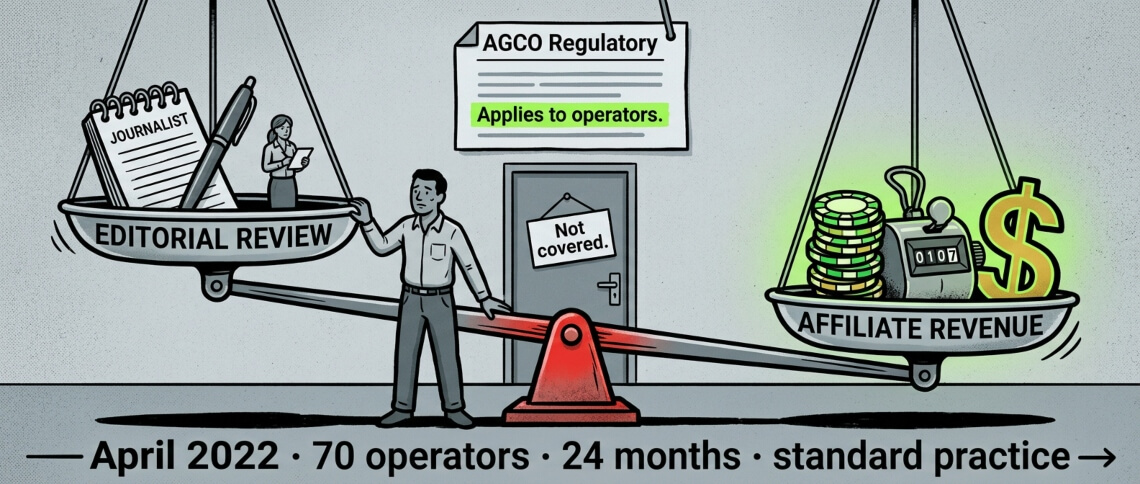
Ontario launched its regulated online gaming market on April 4, 2022. Within 18 months, iGaming operators became among the largest digital advertisers in Canadian media. The Alcohol and Gaming Commission of Ontario (AGCO) reported that 70 licensed operators were active in the province by the end of 2023, spending heavily on digital media placements.
What followed was predictable in hindsight. Several major digital outlets launched dedicated ‘casino review’ sections. Some hired staff specifically to produce content about online gambling platforms – RTP percentages, bonus structures, software providers. The content was technically labelled. It was also written by people whose job depended on maintaining relationships with the platforms they were reviewing.
The structural problem is not that gambling advertising exists. Advertising has always existed. The problem is that the same outlet reviewing a casino platform for editorial purposes is often receiving affiliate revenue when readers click through and register. That is not an advertising relationship. That is a financial stake in the outcome of the reporting. I don’t know of another area where that arrangement would be considered compatible with journalism ethics, but in iGaming coverage, it became standard practice within about 24 months of Ontario’s market opening.
The AGCO published advertising standards for iGaming operators in November 2022, requiring that promotions not target vulnerable individuals and that responsible gambling information be included. Those standards apply to operators. They do not apply to the newsrooms hosting affiliate content.
Native Advertising: The Disclosure Gap in Practice
Native advertising, paid content designed to look like editorial content, has been part of digital media since at least 2012, when BuzzFeed formalized the model. In Canada, the problem is not unfamiliarity. It is that labelling standards have not kept pace with how readers actually process content.
A Reuters Institute study conducted annually since 2019 consistently finds that roughly 80 percent of readers either don’t notice sponsored content labels or cannot recall seeing them after reading the piece. The 2025 Digital News Report found that 54 percent of Canadian respondents consider influencers a primary source of misinformation – a finding that reflects how blurred the boundary between paid and independent content has become across platforms.
| Content type | Disclosure required by CAJ | Common practice | Gap |
|---|---|---|---|
| Sponsored article | Clear label, no editorial byline | Label present, staff byline sometimes used | Byline implies independence |
| Affiliate review | Disclosure of financial relationship | Often absent or in footnote | Reader has no way to assess incentive |
| Brand-funded explainer | Identify funder prominently | “Presented by” in small text | Visually indistinct from editorial |
| Native advertising section | Visual distinction from editorial | Matching font, layout, photography style | Indistinguishable on mobile |
The CAJ policy paper recommended that newsrooms adopt a ‘hard wall’ between advertising and editorial staff, meaning advertising teams have no input into editorial decisions, and editorial staff don’t participate in sponsored content production. Surveying Canadian newsrooms in 2025, HEC Montreal found that 36 percent of journalists didn’t know whether their organization had an AI policy. A similar survey on advertising ethics would likely find comparable gaps.
What a Workable Standard Looks Like
The Reuters Institute’s 2024 Journalism, Media and Technology Trends report identified editorial independence from commercial pressure as the top concern among news industry leaders in Canada and globally. The concern is documented. The solutions are less so.
Three things are consistently recommended in the academic literature and are absent from most Canadian newsroom policies as of 2026. First, revenue transparency: outlets should disclose what share of operating revenue comes from affiliate arrangements and sponsored content. The Boston Globe publishes an annual ethics statement; it does not break down revenue by advertising category. No major Canadian outlet does either.
Second, byline separation: staff journalists should not have their names attached to affiliate-driven content. A byline carries the implicit claim of independent judgment. When that judgment is structured around a financial relationship with the subject, the byline misleads readers about what they’re reading.
Third, category-specific disclosure: generic ‘sponsored’ labels don’t convey the nature of the financial relationship. ‘This section receives affiliate revenue from the platforms reviewed’ is a different statement than ‘This content was produced with support from X company.’ Both are labelled. Only one accurately describes the incentive structure.
None of these requires legislation. All three are within the authority of individual newsrooms and existing professional codes. The CAJ 2019 paper recommended the first two explicitly. Six years later, they remain recommendations, not practice.
This page is for informational and educational purposes. It does not constitute legal or regulatory advice. Journalism ethics codes cited are voluntary; compliance is the responsibility of individual newsrooms and journalists.