

Journalism in Canada: What’s Changed, What Hasn’t, and What to Watch in 2026
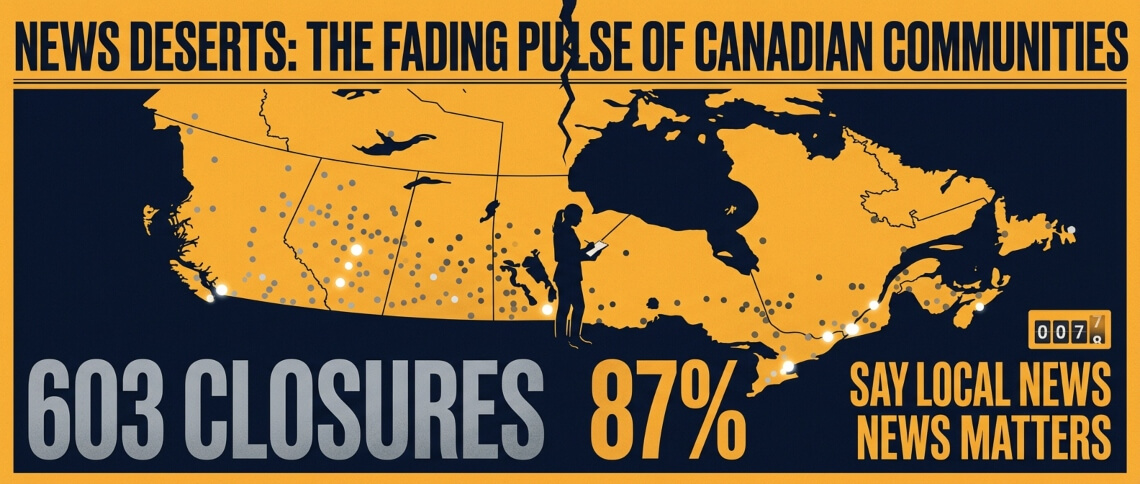
603 local news outlets have closed across 388 Canadian communities since 2008. That figure, updated by Toronto Metropolitan University’s Local News Research Project in October 2025, keeps climbing. And it describes only closures, it doesn’t count the hundreds of newsrooms that cut staff, reduced publication frequency, or quietly went digital-only without making headlines of their own.
Meanwhile, 87 percent of Canadians told an Ipsos poll in January 2025 that local journalism is important to a functioning democracy. The belief is there. The infrastructure to deliver on it is shrinking. That gap, between what Canadians say they want and what the market is producing, defines the journalism landscape in 2026.
This page and its linked Canadian media resources cover five areas where change is most visible: the collapse and restructuring of local news, the AI ethics problem newsrooms haven’t solved, press freedom and its legal limits, what journalism schools are now teaching, and how French-language media accountability works. Each section links to a dedicated page with more details.
603
local news outlets closed since 2008
TMU Local News Research Project, Oct 2025
20th
Canada’s press freedom rank, RSF 2025
RSF World Press Freedom Index (down from 14th in 2024)
62%
of Canadians want fully human-made news
Reuters Institute / Maru, 2025
36%
of journalists don’t know if their org has AI policy
HEC Montréal survey, 400 journalists, 2025
Local News: The Numbers Behind the Crisis
The collapse of local news in Canada is not evenly distributed. Every province and territory except Ontario has seen a net decline in local outlets in communities under 100,000 people since 2008, according to a March 2025 CCPA report. Newfoundland and Labrador tops the list: the average postal code in smaller NL communities has lost roughly a quarter of its local news sources. In Alberta, Quebec, and Manitoba’s smaller communities, the figure is closer to one in seven.
2.5 million Canadians now live in a postal code with one or zero local news sources. That’s 7 percent of the country, double the proportion from 2008. The CCPA researchers put it plainly: the commercial media model that has been dominant in Canada for more than a century is no longer viable. Newspaper revenues fell to $1.6 billion in 2024 – a 17.9 percent drop from 2022 alone.
2024 was the worst year on record for private broadcasting, with a net loss of 14.5 broadcast outlets, driven mainly by CTV cutting newscasts and several Corus stations reducing service. The contrast: Canada’s population grew by a quarter since 2008, from 33 million to 41 million. More people, less local coverage per person.
The picture isn’t entirely dark. Village Media, which started in Sault Ste. Marie, now runs more than two dozen digital properties across Ontario. Google’s 2024 commitment of $100 million annually to Canadian media, distributed through the Canadian Journalism Collective, began flowing in early 2025. The Public Policy Forum’s November 2025 report found 20 percent of Canadians in smaller communities believe there are actually more local news sources than five years ago. But these are patches. The structural problem remains.
The rate of local news deprivation across Canada is snowballing. The commercial media model that has been dominant in Canada for more than a century is no longer viable.
— Canadian Centre for Policy Alternatives, March 2025
AI in Canadian Newsrooms: The Ethics Gap
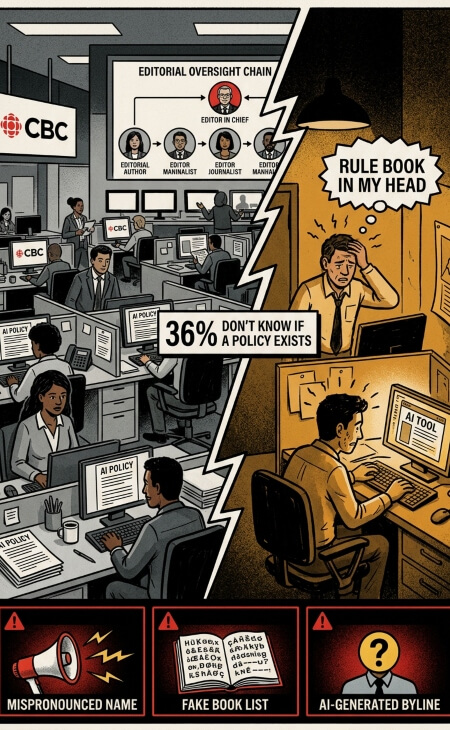
In November 2025, CBC published updated internal guidelines on AI use – mandatory for all staff, covering everything from transcription tools to generative content. Journalists must disclose AI involvement in editorial decisions. Human oversight is required at every stage. The policy runs to several pages and is publicly available.
CBC is the exception. A 2025 HEC Montréal survey of more than 400 Canadian journalists found that 36 percent didn’t know whether their organization had an AI policy at all. Research from TMU’s Local News Research Project found that many journalists across Canadian newsrooms are still operating on what one interviewee described as a “rule book in my head” – personal judgment in the absence of documented standards.
92 percent of Canadians believe newsrooms should have AI policies, according to a survey by Maru Public Opinion commissioned by the Canadian Journalism Foundation. That number has not produced universal compliance. Larger outlets, CBC, the Globe and Mail, The Canadian Press, have robust frameworks and publish them publicly. Smaller newsrooms, constrained by time and resources, typically don’t.
The risks are not theoretical. A Winnipeg Free Press AI audio tool was mispronouncing the Manitoba premier’s name. The Chicago Sun-Times published a fake book list generated by AI. In Canada, The Local’s executive editor uncovered a freelancer in 2025 who turned out to be, under scrutiny, likely an AI-generated identity with bylines already published in the Guardian and Architectural Digest. The standard response from credible newsrooms is to double down on core journalism skills and treat AI as an efficiency tool, not a reporting tool. Whether that approach scales to newsrooms with two journalists and no policy document is an open question.
Press Freedom: What Canada’s 2025 Ranking Actually Means
Canada ranked 20th on the RSF World Press Freedom Index in 2025, down from 14th the year before. The score dropped from 81.7 to 78.75. RSF cited two factors: media ownership concentration and economic fragility. More than 80 percent of Canadian media is controlled by five corporations, according to RSF’s own country profile.
That concentration matters for editorial independence in ways that don’t always show up in explicit editorial interference. When one owner controls most of the papers in a region, a single decision about resources, staffing, or editorial direction affects entire communities. RSF also flagged specific incidents: freelance photojournalist Amber Bracken was arrested in 2021 covering a pipeline protest in northern British Columbia; reporter Brandi Morin was arrested by Edmonton police in January 2024 while covering police action against a homeless encampment. Both cases are documented in the RSF profile. Both raised what the organization called “a chilling effect” on protest coverage.
Canada’s legal framework for press freedom is strong: Charter protection under s.2(b), no licensing requirements for journalists, a functioning shield law. Practical press freedom resources, from the CAJ’s Lawyers for Reporters program to CPJ safety guides, address the gap between legal protection and what reporters face in the field.
Journalism Education and the Schools Producing Canada’s Next Reporters
Leading journalism schools and organizations across Canada operate across the full spectrum of institution types, from Carleton University’s School of Journalism and Communication, which dates to 1945 and now enrolls 1,900 students, to two-year diploma programs at colleges like Sheridan and Humber that feed directly into newsrooms. The range matters: not everyone studying journalism is heading toward a graduate program, and not every newsroom is hiring from them.
Western University offers Canada’s only professional master’s program that teaches both journalism and communications – the MMJC, with applications for September 2026 open as of October 2025. UBC’s School of Journalism, Writing, and Media launched a new course on AI and journalism in 2025-2026, described as focused on exploration, experimentation, and ethical reflection. Carleton introduced an Indigenous journalism certificate, with students completing an in-person intensive on audio journalism in early 2026.
The research community is active. TMU’s Local News Research Project has been producing the most comprehensive data on newsroom closures and openings in Canada, contributing to a growing body of journalism education research that shapes how programs are designed and what they prioritize.
Concordia’s journalism department focuses heavily on digital innovation, decolonizing journalism, and solutions journalism. The Centre d’études sur les médias at Université Laval serves as Canada’s partner institution for the Reuters Institute’s annual Digital News Report – a collaboration that produces the most widely cited survey of news consumption behaviour in the country.
What journalism schools teach increasingly reflects what newsrooms need: data journalism, source verification in a misinformation environment, platform-specific storytelling, and now AI literacy. The gap is in smaller markets. A student who graduates from a Toronto or Ottawa journalism program and moves to a northern community will find a newsroom with no AI policy, no data team, and one editor covering three beats.
French-Language Media Accountability
French-language journalism in Canada operates within a distinct accountability infrastructure. The Conseil de presse du Québec handles public complaints about journalistic conduct in Quebec. Its decisions are public, its process documented. The Fédération professionnelle des journalistes du Québec publishes its own code of ethics. Radio-Canada, the French-language arm of the CBC, maintains a public ombudsman process with published decisions.
The French-language media ecosystem faces the same structural pressures as English-language media, and is governed by the same journalism standards Canada’s major associations have codified – with some additional complexity around federal broadcasting regulation and language law. The Université du Québec à Montréal revived the ProjetJ platform in 2021 after it went dark in 2017, giving francophone journalism educators and researchers a dedicated publication again.
Explore by Topic
Each page below covers one area in depth, with primary sources, specific cases, and documented standards.
News Corrections & Unpublishing
When should newsrooms delete or amend published stories? What industry standards exist, and where the gaps are.
Ethics, Press Freedom & Crisis Reporting
Ethics codes, press complaint processes, source protection under Canadian law, and guidelines for covering kidnappings and hostage situations.
Media Industry & Journalism Education
Circulation data, ownership concentration, newsroom restructuring, and how journalism education and career paths have shifted.
French-Language Media Accountability
The Conseil de presse, Radio-Canada’s ombudsman process, the FPJQ code. Aussi disponible en français.
FAQ
Working journalists, journalism students, media researchers, and anyone tracking the Canadian news industry. The French-language section serves francophone media professionals.
No. This site is editorially independent, with no affiliation with any academic institution, journalism school, or professional organization.
A news desert is a community with no local news source covering it. As of 2025, approximately 2.5 million Canadians, about 7 percent of the population, live in a postal code with one or zero local news sources. That figure has roughly doubled since 2008, according to the CCPA’s March 2025 News Deprivation report. News deserts are not evenly distributed: smaller communities in Newfoundland and Labrador, Alberta, Quebec, and Manitoba have seen the sharpest losses.
Yes, depending on the outlet. For most English-language print and digital media: the National NewsMedia Council (newsmediacouncil.ca) accepts public complaints at no cost. For Quebec media: the Conseil de presse du Québec (conseildepresse.qc.ca). For CBC: the CBC Ombudsman. For broadcast: RTDNA Canada. All processes are free and designed for members of the public – legal representation is not required. Membership in each council is voluntary, so not every outlet participates. This site’s corrections and unpublishing page covers what happens after a complaint is filed.
Primary sources only: TMU Local News Research Project, Reuters Institute Digital News Report, RSF World Press Freedom Index, CCPA, Public Policy Forum, Statistics Canada, and peer-reviewed academic research.